My research sits at the intersection of human-computer interaction, accessibility, and AI. I focus on the design and evaluation of technologies for people with communication disabilities, particularly those arising from stroke and aphasia. I also work on broader questions of how AI governance affects disabled people's access to welfare and public services.
I have authored 15 peer-reviewed publications, including a Best Paper at CHI 2023, a Best Student Paper at ASSETS 2023, a Best Paper nomination at ASSETS 2024, an article in Nature Scientific Reports, and a Routledge book chapter. My doctoral thesis received the 2026 ACM SIGCHI Outstanding Dissertation Award.
Full publication list on Google Scholar and KCL Pure.
Publications
2026
-
Prompting Change in the Welfare State: Co-designing an LLM-Assisted Toolkit of Welfare Stories and Tips with Aphasia Communities
This paper presents the co-design of Advokit's welfare navigation features with people with aphasia — including LLM-assisted benefit story generation, plain-language tips, and community knowledge tools — evaluating how schema-driven agentic pipelines can be designed for safety and accessibility in high-stakes public service contexts.
-
Future Directions of AAC: Co-design of Wearable Communication Technologies with Users with Aphasia
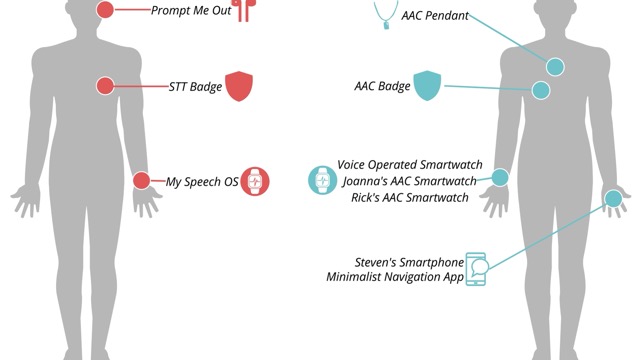
Book chapter synthesising the participatory design programme developed across the PhD, presenting design principles for wearable AAC that emerged from four years of co-design with stroke survivors, clinicians, and speech and language therapists.
-
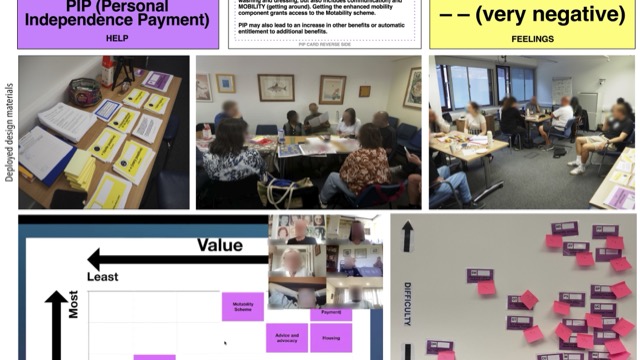
"Computer Says No": Disabled Welfare Experiences and Envisioned Futures Under AI GovernanceThis research examines how digitalization and AI in welfare systems impact disabled individuals, specifically those with aphasia. Through participatory workshops with 42 co-designers, the study identified challenges including "the cost of performing disability" and "navigating digital bureaucracy," while documenting participants' visions for more humane, transparent, and accountable AI-governed welfare systems.
-
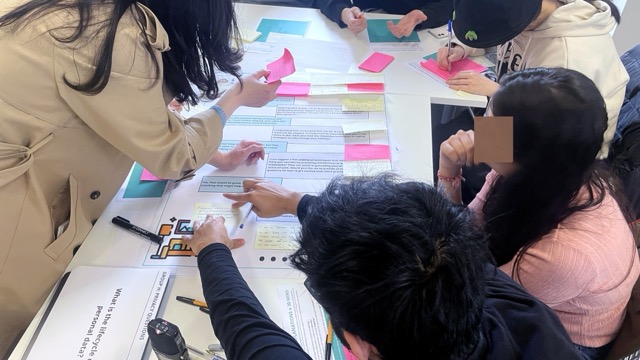
'It literally feeds on data': Co-designing Privacy Conscious and Trustworthy LLM Dialogues with End UsersA replicable co-design methodology for engaging end users in privacy-conscious LLM design. Through workshops with 36 participants across three speculative scenarios — mental health applications, travel assistants, and workplace assistants — the study combines speculative design with Grice's Maxims and Schaub's privacy design space to enable meaningful participation from non-technical users. The co-designed dialogues reveal that users desire dynamic, context-sensitive privacy communication that leverages LLMs' conversational capabilities.
-
Adults Using AAC to Inform the Design of Mimetic Agentic AI
This research explores how adults using AAC can inform the design of AI-powered digital agents that speak on people's behalf. Through interviews with nine AAC users, the study identified communication strategies applicable to conversational AI development, demonstrating how AAC expertise can guide responsible AI design principles including transparency and personhood.
-
Wearable, Discreet Augmentative and Alternative Communication2026 ACM SIGCHI Outstanding Dissertation AwardThis doctoral research explores wearable and discreet AAC technologies for people with aphasia through co-design methods, developing prototypes including smartwatches, smartbadges, and mixed reality devices. The work demonstrates that effective wearable AAC design depends on both user-centred and communal properties, arguing that disabled communities must shape the assistive technologies built for them.
2025
-
"An Old Bastard in Bright Orange Satin!": Zuzenna's Aphasia Diary and Lessons Learned from DIY Augmentative and Alternative Communication
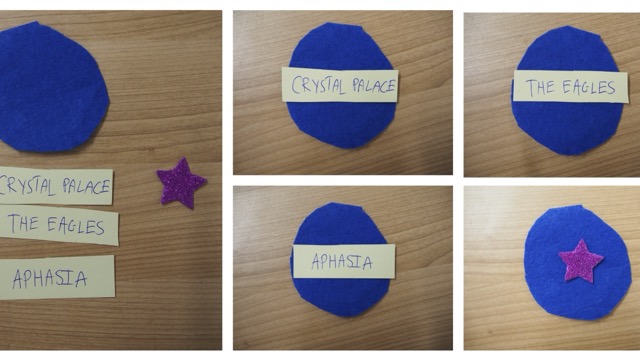
Widespread abandonment of AAC devices among people with aphasia stems from poor personalisation, stigma, and prohibitive costs — many tools reflect top-down, medicalised models shaped by ableist assumptions and commercial agendas. This paper presents a four-month qualitative study of Zuzenna's self-made communication diary: a bespoke, organically evolving DIY AAC tool built around her life after stroke. The findings propose that effective AAC need not be techno-centric or expensive, arguing instead for designs that foster shareability, uphold agency, and support personal growth.
-
Life as an International Computer Science PhD Student with Cerebral Palsy
A longitudinal autoethnographic study following Tianchi, an international PhD student with cerebral palsy, through the final stages of his doctoral journey, using a structured diary method to capture daily reflections on assistive technology use and communication. Thematic analysis reveals three key findings: resilience through creative adaptation of mainstream technologies, the hidden labour of communication challenges in accessing community support, and fragile interdependencies between care and assistive technology. The work calls for more participatory, first-person research approaches with communities living with CP.
-
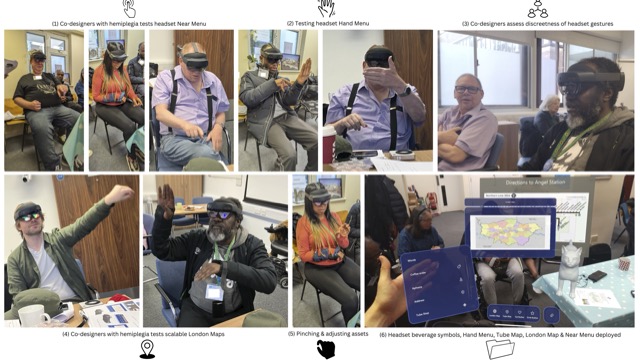
Making Smartglasses Accessible: Perspectives and Prototypes from Co-design with People with AphasiaThree co-design workshops with people living with aphasia (N=14) examined perspectives on smartglasses and prototyped potential applications for general and aphasia-specific support. While co-designers were enthusiastic, they raised concerns about interaction difficulties and the socially conspicuous form-factor of current designs. Evaluation of a mixed reality HoloLens HMD found that standard hands-free interaction was perceived as publicly awkward and inaccessible for participants with vision impairments or post-stroke paralysis, highlighting the need for more inclusive smartglass design.
-
"I use video calling in all areas of my life": Understanding the Video Calling Experiences of Chronically Ill People
The largest online survey study (N=55) of chronically ill people's video calling experiences in the US, examining routines, facilitators, and barriers across work, healthcare, and social domains. Findings confirm that chronically ill people heavily depend on video calling to cope with everyday life, while also showing it can detrimentally exacerbate cognitive (brain fog), emotional (self-consciousness), and physical challenges (migraines). The paper offers actionable design recommendations to improve the accessibility of video calling for chronically ill people.
-
Accessibility in Austerity: Formulating Strategies for Accessibility Research in Constrained Times
Accessibility research and the disabled communities it serves face growing threats from austerity — reduced public funding, government research cuts, and major technology firms redirecting focus toward the global AI competition. This workshop convened accessibility researchers, students, and practitioners to explore strategies for navigating these constraints within the UK context and beyond, developing approaches for managing current challenges while cultivating a community of resilient, impact-driven accessibility researchers.
2024
-
Looking Past Screens: Exploring Mixed Reality and Discreet AAC DevicesBest Paper Nomination — ASSETS 2024
AAC technologies are typically fixed-form-factor mobile devices that are physically obtrusive and visually identifiable, perpetuating public stigma and limiting non-verbal communication — particularly for stroke survivors with aphasia and hemiplegic paralysis. This work co-designs mixed reality and discreet AAC with people living with aphasia, culminating in three high-fidelity prototypes: Pico-project AAC, Prompt AAC, and Holo AAC, embodying projection, worn audio, and headset-driven mixed reality respectively. Focus group evaluations reflect on the possibilities of present and future mixed-reality technologies to augment communication.
-
Breaking Badge: Augmenting Communication with Wearable AAC Smartbadges and Displays
Most AAC interventions undermine users' agency by obstructing intuitive multimodal communication pathways — limited speech, paralinguistics, and non-verbal communication. Co-designing with 19 people living with aphasia, this work prototyped two low-input wearable AAC displays that scaffold pre-existing communication abilities: InkTalker, a low-power eInk smartbadge designed to discreetly reveal invisible disabilities, and WalkieTalker, an app that converts smartphones into a feature-rich public display operable via multimodal input. Both devices enabled participants to socialise interdependently and augment their natural communication.
-
Beyond Repairing with Electronic Speech: Towards Embodied Communication and Assistive Technology
Western philosophical traditions have strongly favoured dualist interpretations of consciousness, but this paper argues that adopted assistive technologies become embodied and extend intentionality within environments. Drawing on phenomenological theory and a co-design case study with people living with aphasia, the work demonstrates how an embodied framework supports a more multidimensional account of experience and motivates a shift away from AAC that seeks to "repair" users' speech. The paper also outlines concerns about nascent technologies that risk disembodying users and limiting accessibility.
-
Public Assistive Displays: Employing Public Interactive Displays to Improve Public Transport Access 4AllAccess to public transport is vital for equitable participation in society, yet communicating complex personal needs to co-located passengers and staff in dynamic transport environments creates significant barriers. This late-breaking work presents the 4All Display — a public interactive display (PID) technology probe that proactively recognises passengers' contextual needs and discreetly informs co-located travellers about their fellow passengers' needs to support more positive journey outcomes.
2023
-
Envisioning the (In)Visibility of Discreet and Wearable AAC DevicesBest Paper — CHI 2023
AAC device abandonment is linked to the stigma of device visibility and its obstruction of non-verbal communication — yet visible AAC is also strategically useful for setting conversational expectations. This work builds three high-fidelity AAC prototypes with different form factors and visibility with communities with complex communication needs, specialists, and stakeholders. Two subsequent focus groups with people living with aphasia then used convergent and divergent co-design methods to ideate seven discreet and wearable low-fidelity AAC concepts that directly address the tension between visibility and discretion.
-
Watch Your Language: Using Smartwatches to Support CommunicationBest Student Paper — ASSETS 2023
Mainstream AAC devices are socially conspicuous, poorly portable, and obstruct vital non-verbal communication — making discreet, wearable alternatives essential for an ageing population with growing complex communication needs. Through participatory design with people living with aphasia, this work designed and evaluated two discreet smartwatch apps: Watch Out for public communication support, and Watch In for private cognitive support. Participants successfully used both apps — critically, without restricting their agency or non-verbal communication.
2022
-
State of the Art in AAC: A Systematic Review and Taxonomy
A systematic review of 562 articles from ACM DL and SCOPUS examining high-tech AAC devices for people with complex communication needs, where challenges including high abandonment rates and inadequate solutions persist despite effective use by many. The review provides a taxonomical overview of current AAC devices — interaction modalities, characteristics, communities of focus, and methodological approaches — contrasting findings with broader HCI literature to identify future research directions and reassess existing research norms.
-
Wearable, Discreet, Augmentative and Alternative CommunicationDoctoral consortium paper presenting the PhD research programme on wearable and discreet AAC for people with complex communication needs, particularly aphasia. Motivating the work are persistent challenges with existing high-tech AAC — high abandonment rates, cultural insensitivity, and stigma from device visibility in public — with the thesis arguing for novel wearable and discreet assistive technologies that support communication subtly and effectively in real-world settings.